
- Home
- Destinations
- Aswan to Abu Simbel Tour: Weekly Boat Trips with Dabuka Tours
- Bedouin Culture and Boat Safari
- Discover Nubia: A Journey Through Time and Tranquility
- Embark on an Enchanting Journey: Exploring Egypt by Boat
- New Year’s Eve Under the Stars: A Captivating Voyage on Lake Nasser
- Philae Temple – Luxury Safari Boat and Oases
- Lake Nasser Yoga Retreat aboard the Dabuka Blue
- Dance Heritage Show: Celebrate Egyptian Culture
- Explore Wadi El Natrun: Ancient Monasteries and Christian History
- Felucca Ride at Sunset in Luxor
- Private Plane Adventures – Soar Above the Pyramids
- Cairo by Night. Why it is a Must Do!
- Sand Burial Treatment: A Holistic Healing Experience in Siwa Oasis
- Swimming with dolphins at Dolphin house Sataya Reef
- Skydiving Egypt – A Unique Paramotor Flight Experience 1.67 out of5
- Services
- About Us
- Plan Your Trip
- Resources
- Contact
 Deutsch

- Home
- Destinations
- Aswan to Abu Simbel Tour: Weekly Boat Trips with Dabuka Tours
- Bedouin Culture and Boat Safari
- Discover Nubia: A Journey Through Time and Tranquility
- Embark on an Enchanting Journey: Exploring Egypt by Boat
- New Year’s Eve Under the Stars: A Captivating Voyage on Lake Nasser
- Philae Temple – Luxury Safari Boat and Oases
- Lake Nasser Yoga Retreat aboard the Dabuka Blue
- Dance Heritage Show: Celebrate Egyptian Culture
- Explore Wadi El Natrun: Ancient Monasteries and Christian History
- Felucca Ride at Sunset in Luxor
- Private Plane Adventures – Soar Above the Pyramids
- Cairo by Night. Why it is a Must Do!
- Sand Burial Treatment: A Holistic Healing Experience in Siwa Oasis
- Swimming with dolphins at Dolphin house Sataya Reef
- Skydiving Egypt – A Unique Paramotor Flight Experience 1.67 out of5
- Services
- About Us
- Plan Your Trip
- Resources
- Contact
- Deutsch
Fayoum Oasis: “Wadi El Hitan – finally!” Stefan, my travel companion, exclaims as we drive along the pale limestone track. The sun is high, dust swirls beneath the tires, and the landscape unfolds before us like an endless panorama.
We start in the Fayoum Oasis, passing lakes, green fields, and scattered palm trees. Even the drive itself sets the mood for the Valley of the Whales – wide, bright, and clearly shaped, with mountain ranges in the distance, gentle hills, sand, and flat limestone plates.

Arrival at the Wadi El Hitan Visitor Center
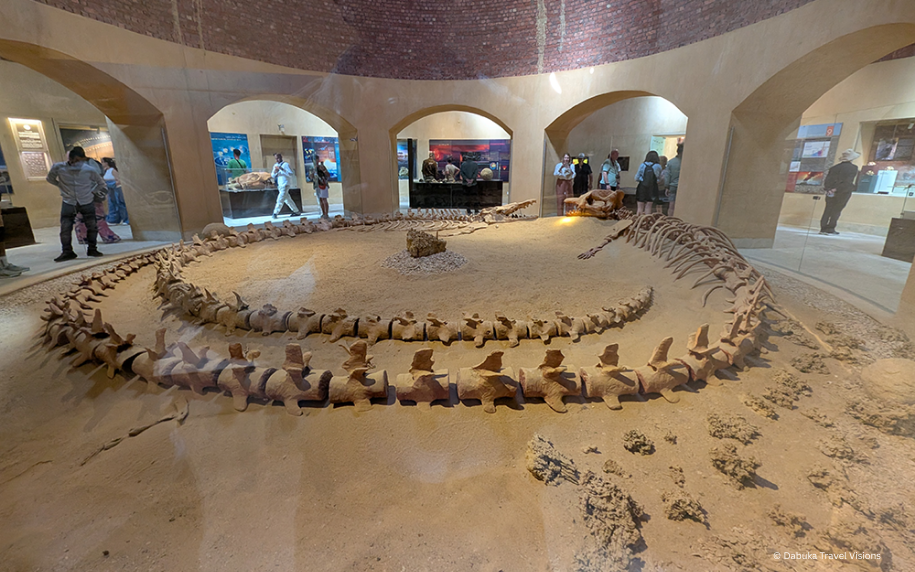
At the entrance to Wadi El Hitan, a small visitor center with a museum and rest house awaits us. We grab some refreshments and study the information panels in the museum before setting off on foot.

“The fossils lie exactly where the whales actually lived 40 million years ago,” the ranger explains.
“And they still had legs?” Katharina asks in disbelief.
“Yes, small rudiments, hardly larger than a hand,” he replies.
We laugh. That single fact makes the place even more fascinating.
Exploring the Valley of the Whales
The circular trail through Wadi El Hitan is easy to walk, yet varied: small hills, limestone slabs, and flat stretches. Again and again, we stop.
“Look at this vertebra!” Katharina calls out, bending down.
“Almost as big as my forearm,” Stefan adds.
We scramble lightly over rocks, take photos, compare perspectives, and enjoy the combination of movement and discovery. The fossils lie openly in the landscape, not behind glass – an active experience for the eye, the hand, and the camera.

Fayoum Oasis: Lesser-Known Facts About Wadi El Hitan
Between walking and photographing, we discuss a few surprising details:
- Discovery: The valley was discovered by Egyptian geologists in 1989.
- UNESCO World Heritage Site: Recognized in 2005.
- Evolution: Some whales still had rudimentary hind legs.
- Preservation: Fossils are preserved in situ, protected by limestone slabs.
- Diversity: In addition to Basilosaurus, remains of sea cows, turtles, and sharks have been found.
“It’s incredible to be standing so close to prehistoric whales,” Stefan says.

Museum and Rest House: Informative Breaks
After completing the loop, we return to the rest house. We drink tea and water, gaze out over the landscape, and reflect. The museum complements the experience with concise, well-presented information – just enough to help make sense of what we have seen outside, without overwhelming.
Why a Trip to the Fayoum Oasis and Wadi El Hitan Is Worthwhile

- Active exploration: walking, climbing, photographing, changing perspectives.
- Living history: fossils and landscape connect knowledge with direct observation.
- Pure nature: no staging, no crowds – just authentic terrain.
- A unique combination: green fields, lakes, and villages of the Fayoum Oasis alongside the prehistoric world of Wadi El Hitan.
Fayoum Oasis – Final Thoughts

A visit to Wadi El Hitan is active, exciting, and at the same time deeply educational. The Fayoum Oasis provides the scenic setting – lakes and fields, calm and everyday life all around. Wadi El Hitan itself shows how fascinating Earth’s history can be when discovered step by step.
Anyone who loves movement, discovery, and nature should not miss this excursion – a truly memorable experience for all the senses.